

Out-of-pocket
One price file → one exact number per door
Price transparency, finished
What will this cost me, there?
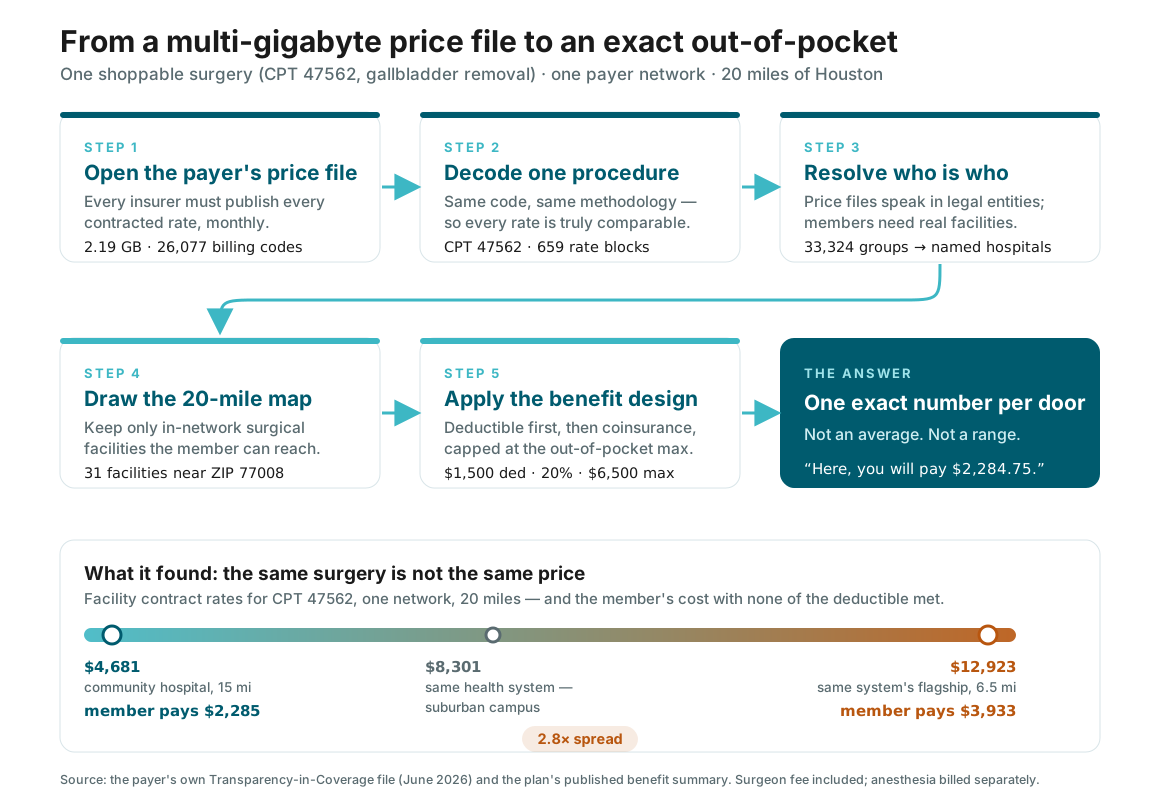
One insurer's federally required price file, one everyday surgery (laparoscopic gallbladder removal, CPT 47562), one Houston ZIP code. Turned into the only number a member actually wants: an exact out-of-pocket at every in-network door within 20 miles.
2.8×
spread on the facility contract — same surgery, same insurer, same 20 miles
$4,622
gap between two campuses of the same health system, pricing the same operation
~$1,650
kept by the member who drives fifteen minutes further
What it found
One exact number per door
Member cost = facility rate plus the typical in-network surgeon fee, deductible unmet. Anesthesia is billed separately by time.
| Facility | Contracted rate | Member pays |
|---|---|---|
| Community hospital, east side | $4,681 | $2,285 |
| Large system, suburban campus | $8,301 | $3,009 |
| Academic flagship, Texas Medical Center | $12,923 | $3,933 |
The most striking line is not cheapest-versus-priciest. It is that a member choosing by brand name alone cannot see any of this — and a member with this list sees it in one glance.
The pipeline
Five steps, honestly described
Nothing here requires heroic infrastructure. The barrier is not file size — it is decoding methodologies, resolving identities, and applying the benefit design correctly.
Step 1
Open the payer's price file
Every insurer must publish every contracted rate, monthly. This network's June file: 2.19 GB, 26,077 billing codes — one of the manageable ones.
Step 2
Decode one procedure
All 659 rate entries for CPT 47562 mix hospitals with surgeons and flat rates with percent-of-charges. We keep what is genuinely comparable and set aside the rest, on purpose.
Step 3
Resolve who is who
Price files speak in legal entities nobody recognizes. A provider-identity crosswalk collapses 33,324 provider groups into a clean list of named facilities at real addresses.
Step 4
Draw the 20-mile map
Within 20 miles of the member's ZIP, 31 in-network hospitals and surgery centers hold a flat contracted rate for this operation.
Step 5
Apply the benefit design
The plan's own published cost-share: $1,500 deductible, then 20% coinsurance, $6,500 out-of-pocket max. Deductible first, coinsurance on the rest, cap applied. Not an estimate engine — arithmetic.
The answer
One exact number per door
Not an average. Not a range. “Here, you will pay $2,284.75.”
Why “exact” is the honest word
Exact rates, exact cost-share — stated scope
The rates are the contracted amounts in the payer's own federally required file. The cost-share is the plan's published design. A trustworthy tool says what keeps the final number from being a guarantee, on the page:
- Anesthesia is billed separately, by time.
- Percent-of-charge contracts cannot be resolved to a dollar figure in advance — so they are set aside, visibly.
- A member's remaining deductible has to come from the member or the payer's CMS-mandated patient-access APIs, which make this math fully automatic.
The full walkthrough, with method notes: read the write-up.
Your market already looks like this to someone
Payers, employers, and navigation vendors are building exactly this view — with your rates in it. See your own position in the file the way everyone else sees it.